🛞Palace Reassignment in Doushu Astrology 轉宮
🧬 The Life Chart
In Doushu Astrology, a person’s birth chart is called the Life Chart (ming pan 命盤). The Life Chart describes a person’s life and fortune. It consists of 12 Palaces arranged in a circle. Each Palace represents one of the 12 Aspects of Life and a specific Period of Fortune.
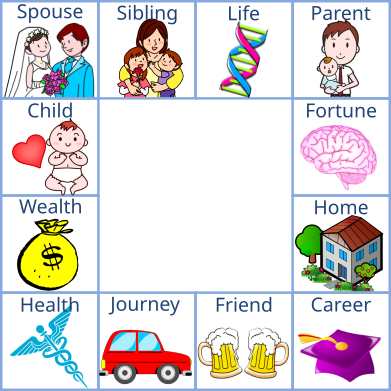
↪️ The 12 Palace Numbers and Sequence
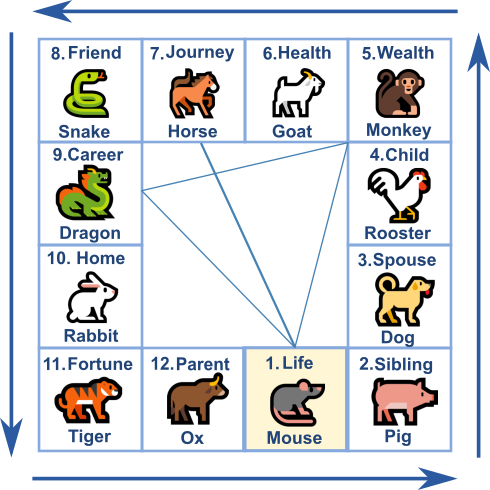
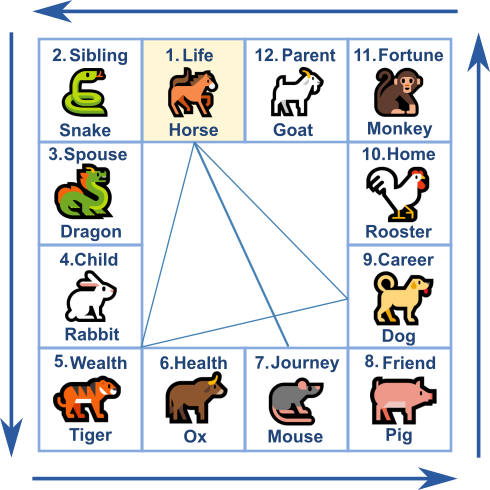
The 12 Palaces follow a fixed sequence and rotate counterclockwise on the Life Chart. This sequence is the same for everyone. Each Palace is assigned a number, beginning with 1 (Life Palace) and ending with 12 (Parent Palace). The starting point of the Life Palace varies according to a person’s date of birth.
🛞 The 12 Palace Sequence:
🌱 1. Life → 2. Sibling → 3. Spouse → 4. Child → 5. Wealth → 6. Health → 7. Journey → 8. Friend → 9. Career → 10. Home → 11. Fortune → 12. Parent
🎯 Target Palace (Self Palace, Inner Palace)
In Doushu Astrology, every matter or event corresponds to a specific Palace on the Life Chart. The Palace representing the Subject of Interest is called the Target Palace. It can also be referred to as the Self Palace, or the Inner Palace. Identifying the correct Target Palace is the first step in addressing a person’s inquiry or concern.
Examples:
- The Spouse Palace is the Target Palace when evaluating a spouse’s personality.
- The Annual Wealth Palace is the Target Palace when assessing a person’s finances for a specific year.
- The Health Palace is the Target Palace for health-related matters.
- The Life Palace is the Target Palace when evaluating a person’s overall life.
🎯 Multiple Target Palaces
Some Subjects of Interest require evaluating more than one Palace, because different Palaces may reflect different aspects of the same subject.
Example — examining a future spouse:
- Spouse Palace → Represents the spouse’s general personality.
- Friend Palace (the Spouse Palace’s Health Palace) → Represents the spouse’s body type and inner feelings (e.g., slim, chubby).
- Life Palace (the Spouse Palace’s Fortune Palace) → Reflects the spouse’s interests, hobbies, and outlook on life.
🛞 Palace Reassignment (Palace of Palace 宮之宮)
In Doushu Astrology, Palace Reassignment is the process of temporarily renaming a Palace and its related Palaces based on the Subject of Interest. There are two methods of Palace Reassignment: Palace Shift and Ordinal Indexing.
Palace Shift
Each Target Palace has its own set of 12 palaces, arranged in the same sequence as the 12 Natal Palaces (the original 12 palaces on the Life Chart). Palace Shift is the process of temporarily assigning new labels to the 12 Natal Palaces so that each label can serve as a reference for evaluating matters related to the Subject of Interest (the Target Palace).
The new labels use the same names as the 12 Natal Palaces; however, the starting point is shifted to a new position— to the Target Palace—which is why this process is called Palace Shift.
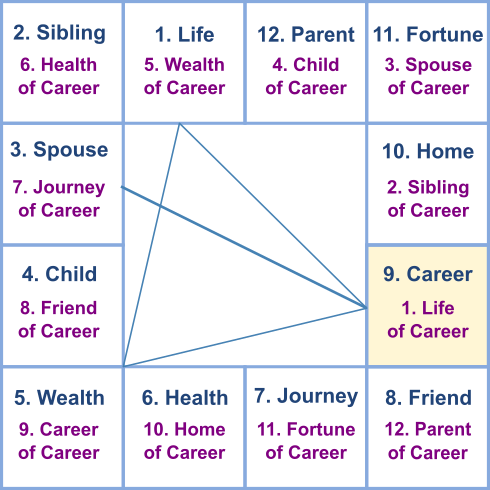
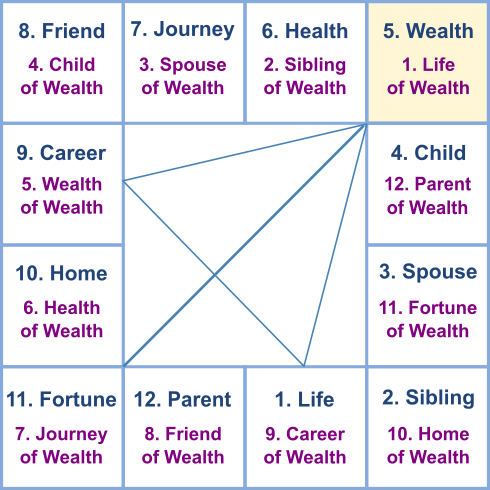
Example1:
If the subject of interest is a person’s career, the Target Palace is the Career Palace. The Career Palace becomes the starting position for labeling matters related to the person’s career.
In this case, the Career Palace is labeled Life (1) of Career (9), where "1" is the palace number for the Life Palace, and "9" is the palace number of the Career Palace in the original Natal chart. The next palace, the Sibling Palace (2), becomes Sibling of Career (9); the Spouse Palace (3) becomes Spouse of Career (9); and so on for the remaining palaces.
Example2:
If the subject of interest is a person’s Wealth, the Target Palace is the Wealth Palace. The Wealth Palace becomes the starting position for labeling matters related to the person’s wealth.
In this case, the Wealth Palace is labeled Life (1) of Wealth (5), where "1" is the palace number for the Life Palace, and "5" is the palace number of the Wealth Palace in the original Natal chart. The next palace, the Sibling Palace (2), becomes Sibling of Wealth (5); the Spouse Palace (3) becomes Spouse of Wealth (5); and so on for the remaining palaces.
Ordinal Indexing:
Used for evaluating matters involving multiple similar instances. The position of the Target Palace remains fixed as the first Target Palace. Subsequent Palaces are sequentially enumerated as the "Second Target", "Third Target”, and so on, moving either clockwise or counterclockwise.
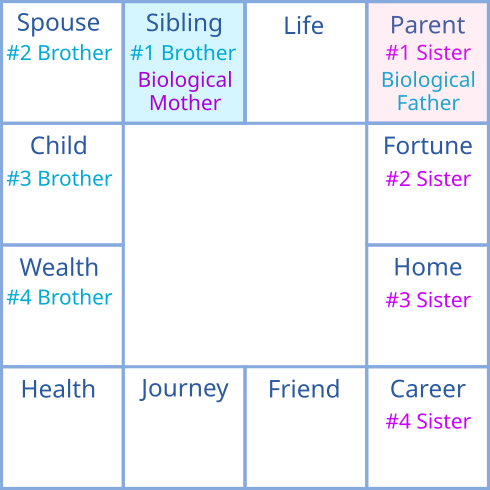
Example 1:
The subject of interest is the relationship with one’s biological brothers. The person has three biological brothers, meaning there are multiple Target Palaces. Since the Sibling Palace represents the first biological brother, it is assigned as the first Target Palace. In a counterclockwise direction, the Spouse Palace becomes the second biological brother, and the Child Palace becomes the third biological brother.
Example 2:
The subject of interest is the relationship with one’s biological sisters. The person has four biological sisters, meaning there are multiple Target Palaces. Since the Parent Palace represents the first biological sister, it is assigned as the first Target Palace. In a clockwise direction, the Fortune Palace becomes the second biological sister, the Home Palace the third biological sister, and the Career Palace the fourth biological sister.